> For the complete documentation index, see [llms.txt](https://guide.bocto.octopeeps.com/llms.txt). Markdown versions of documentation pages are available by appending `.md` to page URLs; this page is available as [Markdown](https://guide.bocto.octopeeps.com/plugins/verify-roles/verification-rules/specific-editions-token-id-s-based-roles.md).
# Specific Editions Token Id(s) Based Roles
This rule type allows you to assign a specific role to your **Discord** users based on a specific token ID(s) from a particular **Editions NFT collection type** they own. Guaranteed to work with the [supported **EVM** chains](/basics/chains-marketplaces.md#supported-evm-chains). Didn't test on **Solana**.
## Explanation of the Fields.
* In the **Rule Name** field, enter your desired rule name.
* In the **Blockchain** dropdown, select the blockchain where your collection contract is deployed.
* In the **Contract** field, enter the valid 1/1 type [collection contract address](/appendix/getting-collection-contract-address.md) (ERC-1155 for **EVM** chains).
* In the **Token ID(s)** field, enter the ID (or IDs) of NFT(s) a user should hold to get the role.
* In the **Role** dropdown, select the prepared **@Role** you wish to assign to the holders.
{% hint style="danger" %}
Be especially careful when setting the **Contract** field for **Solana** collections! Check this [link](/appendix/getting-collection-contract-address.md) before starting!
{% endhint %}
{% hint style="danger" %}
If you set up the **Collectibles** collection type instead of the **Editions** type, no error will occur, but the rule won't work!
{% endhint %}
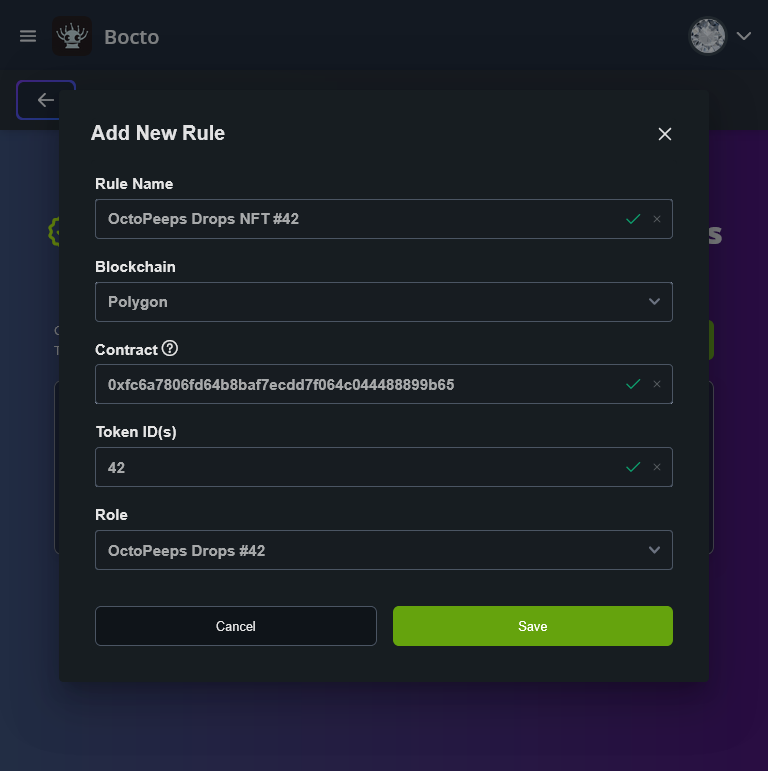
## Setting Up Just One ID.
In case you want to assign users a **@Role** depending on whether they have only one NFT with the specific ID, it's just as easy:
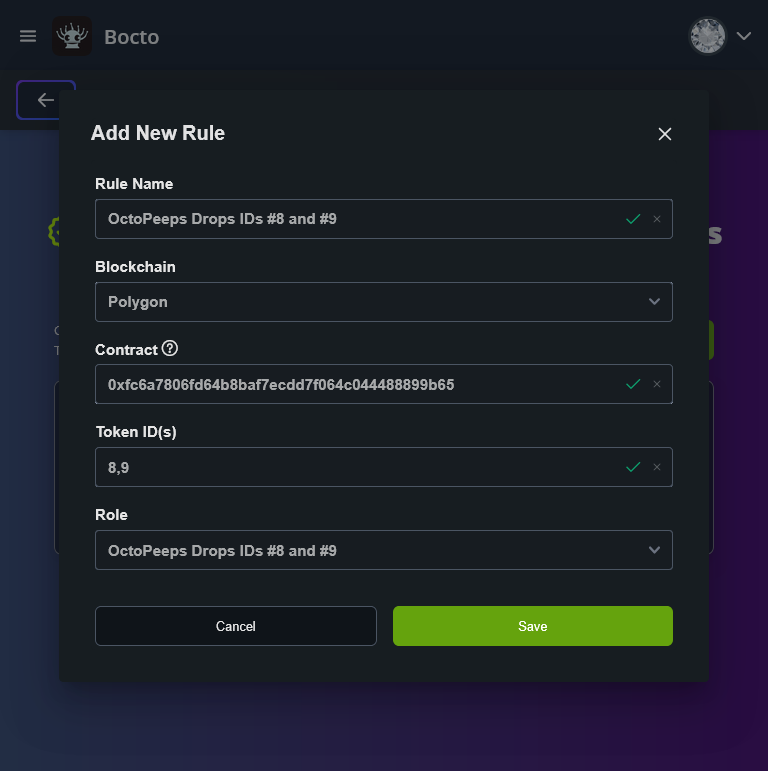
## Setting Up Multiple IDs.
In case you want to assign users a **@Role** based on whether they possess one of the NFTs with specific IDs, you can list them separated by commas without spaces:
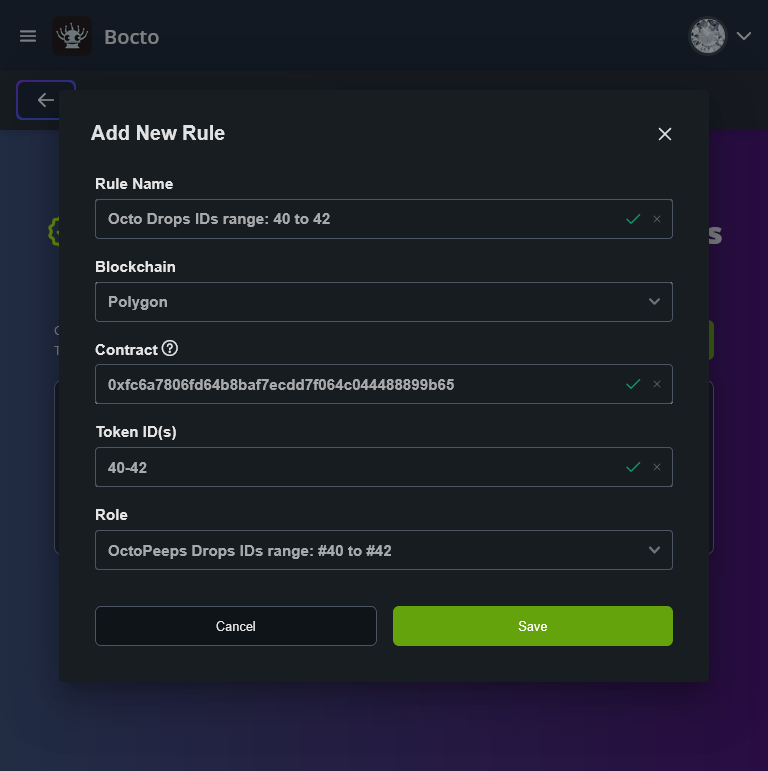
## Setting Up a Range of IDs.
If you want to assign users a **@Role** based on whether they possess NFTs with specific IDs within a certain range, you can enter the first and last IDs:
## Mixing Up Multiple IDs and ID Ranges.
You can also mix and flexibly combine the last two variants like this:
{% columns %}
{% column %}
{% hint style="success" %}
10,12,14-35
{% endhint %}
{% hint style="success" %}
10,12,14-35,56,59
{% endhint %}
{% endcolumn %}
{% column %}
{% hint style="success" %}
14-35,56-59
{% endhint %}
{% hint style="success" %}
10,12,14-35,45,56-59
{% endhint %}
{% endcolumn %}
{% endcolumns %}
This allows you to use only one rule at a time to set IDs and ID ranges separately, rather than using several rules simultaneously.
{% hint style="warning" %}
If you set more than one ID, the rule will be assigned if the holder has any NFT from the list, not all of them!
{% endhint %}